At first glance, the City-catalogued teak pipe is a single length of timber.[1] Its circular bore and tapered end connect it to a much larger story: the movement of water through Cape Town’s early settlement.[1] The catalogue identifies the object as Teak Water Pipe, item ID CTCC\88\174, record 321.[1] It lists teak, dimensions of 1,770 × 410 × 345 mm, an unknown producer and no date.[1]
The City’s catalogue narrative describes an early water network of canals and wooden pipes carrying water from mountain streams to the settlement and ships at Table Bay.[1] It notes that teak was imported because local woods were considered too soft for the purpose; the pipes were made in sections and joined with copper collars.[1] The narrative records cast iron becoming standard around 1812.[1] These details describe the network, not a confirmed date or installation for this specimen.[1]
A hollow conduit
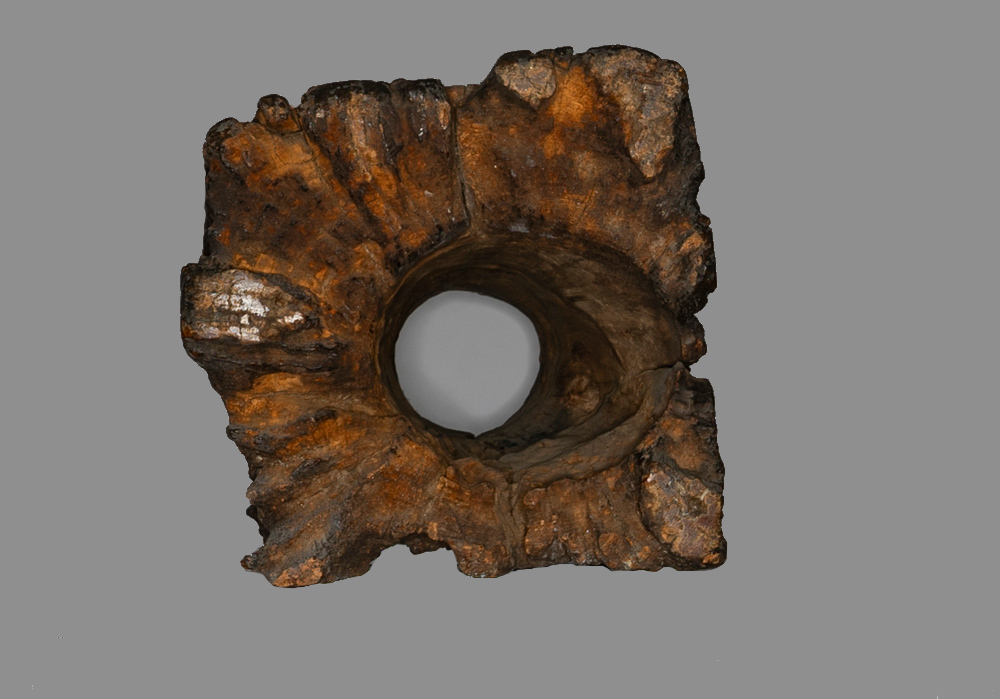
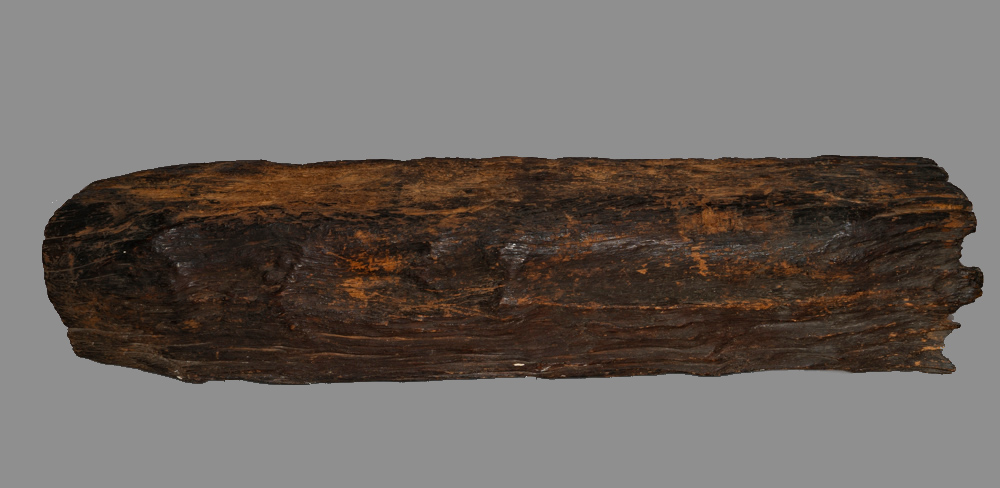
The three catalogue photographs show the pipe from an angled view, along its length and through the end.[1] The end view reveals a circular bore within a roughly squared exterior.[1] The profile records a long, uneven timber section; the angled view shows its tapered end.[1] None of the photographs includes a scale or a visible maker’s mark.[1]
The City record gives dimensions of 1,770 × 410 × 345 mm.[1] The record identifies its material as teak, but does not name a maker, watercourse or structure.[1] The visible form supports its catalogue identification as a pipe; it cannot, by itself, establish where or when this section was used.[1]
No installation view accompanies the record, and no installation is documented for this specimen.[1]
“an early
water network of canals and wooden pipes
carrying water from mountain streams to the
settlement and ships at Table Bay.”
A provenance note
The City’s text associates a pipe of this kind with restoration work at Tuynhuys in the 1960s, while qualifying whether the recovered pipe was this specimen.[1] No reference has been found confirming that the present object was the pipe recovered there.[1] Its exact findspot, date and original installation remain unconfirmed.[1]
The Tuynhuys note supports an association with a pipe of this kind, not a confirmed findspot for this specimen.[1] The item record names no specific watercourse, building or excavation as its origin.[1]
A separate waterworks history
The City’s Woodhead Dam Museum presents another strand of Cape Town’s water history, with construction-era objects including a steam train, tools, instruments and flow-measuring equipment.[2] Engineering historian J. Murray examines Woodhead Dam as a distinct infrastructure project and its place in the expansion of water supply.[3] The Teak Water Pipe record does not connect this specimen to the dam.[1]
Together, these records show the range of material evidence associated with Cape Town’s water history.[1][2][3] They do not establish that this pipe belonged to a particular dam, watercourse or later municipal project.[1] The catalogue records the material, dimensions and form; it provides no date, maker or precise provenance.[1]